Hosting a benefit concert for drummer Janusz Stefański on October 6, 2002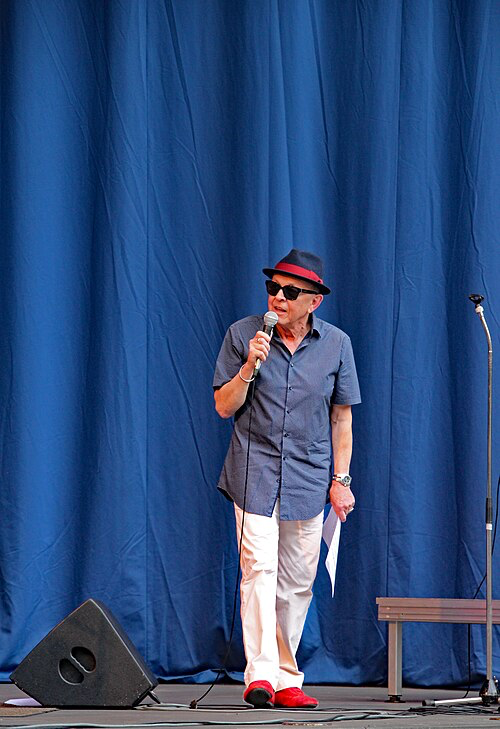
Foto: Frank C. Müller
On behalf of the Frankfurt Jazz Initiative, I would like to welcome you. My name is Wolfram Knauer, and I run the Jazzinstitut Darmstadt in the neighborhood.
On June 29, 2002, Janusz Stefański and some friends were planning to drive to Cologne to attend a concert by his friend and long-time musical colleague Tomasz Stańko at the Philharmonie. Near Idstein, he was tailgated by a speeding driver, causing him to lose control of his car, crash into several guardrails, and ultimately suffer a total loss.
Janusz suffered a torn tendon in his left shoulder in the accident, which will keep him out of action for several months. He has undergone surgery and is currently undergoing pain management and ongoing physiotherapy rehabilitation treatment with the aim of achieving the fullest possible recovery.
Accidents are terrible strokes of fate for anyone, but for a drummer, they threaten their very livelihood. When Vitold Rek came up with the idea of organizing a benefit concert for his friend Janusz Stefański, all the musicians he had worked with in such a wide variety of ensembles quickly agreed to take part: fellow musicians from the old days, some Polish musicians who, like him, had at some point decided to pursue their musical future in Germany, colleagues from the universities where Janusz had been teaching for years, pupils and students.
We know Janusz Stefański as a powerful drummer, a person full of ideas and full of energy to implement his ideas, to communicate them to others with enthusiasm and inspiration, as an organizer who can make things happen that others would probably give up on quickly. So it's no surprise that, at some point during the preparations for this benefit concert, Janusz himself took over the project management and thus realized his dream of a multimedia concert/art project.
Even though the occasion for today's concert is an unpleasant one, our presence here today is also a testament to the friendship that Janusz has gained over the years and a wonderful demonstration of the solidarity within a scene that is actually quite small, where everyone is so busy working on their own projects that they sometimes rarely get a chance to visit their colleagues' workshops. But today, Janusz Stefański's friends and colleagues are all coming together out of solidarity to help him, but also to show him their respect, affection, and friendship.
The occasion is not exactly a happy one, but the evening should be encouraging. Janusz, with all of us here today, every note that is played, every image we see, every word we speak is also a sign of support for you and your health. And keeping your fingers crossed is not a sad thing, but something incredibly optimistic. Because what impresses me, and perhaps all of us, so much about you is that you look at the world with optimism, plan, dream, and make your dreams come true—even in a situation like the one you are currently facing.
So let's keep our fingers crossed and celebrate a wonderful evening together. There will be films and band recordings and, of course, live music, all kinds of acoustic and visual impressions. It will be a long evening, chaos and harmony—and that is also the title Janusz Stefański has given to the evening: “Chaos & Harmony.”
***
Janusz asked me to include a few explanations about the individual items on the agenda.
So let's get started:
In the first part, we will see two films. It begins with “Sound Track”, a film by Polish filmmaker Kuba Gontarczyk and his wife, the sought-after Hungarian stage designer Anna Kiraly. The two went into Manhattan's subway stations and documented the musical happenings in the corridors and on the platforms: street musicians underground! The result is a highly musical film. Not a jazz film, but a music film that documents the whole range and musical colorfulness, the intensity and at the same time the momentary nature of such subway musicians. The film had its world premiere in December 2001 in New York and will be shown in Europe for the first time tonight. Incidentally, the film was shot before September 11, 2001.
Afterwards, we will watch the television documentary “Jazz Drummer Janusz Stefański”, which aired on Hessischer Rundfunk in 1999. Once again, hr had become aware of Janusz Stefański when he began organizing several concerts in the run-up to the 2000 Book Fair, which had a special theme of “Poland.” Polish director Andrzej Falber, who worked for ARD and ZDF at the time and now lives in Warsaw, visited Janusz at home and filmed a concert at the Theaterhaus, which also featured many musicians from the Frankfurt scene. Some of those in the audience tonight may recognize themselves in the footage.
Before the break, we will hear an excerpt from the last studio recording with Janusz Stefański, recorded with the NDR Big Band in February 2002. The fragment is part of a longer composition, “The Raven”, by saxophonist Joachim Ullrich, who is also Janusz's colleague in the music department at the University of Mainz. Joachim Ullrich would have liked to be here tonight, but he had to leave for Madagascar today with the Kölner Saxophon Mafia for concerts.
***
The second half of the program begins with another band recording. When Janusz's old friend Tomasz Stańko heard about this concert, he would have loved to be there himself. But Stańko is currently playing in Finland, preparing for a US tour after his latest album was so enormously well received in the United States. Stańko definitely wanted to be there, though, and in mid-September he recorded a minute of music for Janusz, a piece entitled “For Janusz,” which we will hear first.
After that, the stage will fill up.
A few words about the musicians performing this evening:
There could have been considerably more musicians on stage. Among the musicians who had to cancel because of other concert commitments were Tomas Stanko and Joachim Ullrich, as well as Christof Lauer, Christoph Spendel, the Jackson Singers, and Herbert Joos, who is listed on the program but was unable to attend due to scheduling conflicts.
I should also convey warm regards from Werner Wunderlich, who himself represents a kind of bridge between Frankfurt and Poland: he was the one who initiated German-Polish jazz contacts after the war in 1957, when he brought Albert and Emil Mangelsdorff with the Frankfurt All Stars to the jazz festival in Sopot on behalf of the German Jazz Federation. And... one of the last concerts Janusz Stefański played after his accident was the concert he gave together with Vitold Rek on August 15 in Werner Wunderlich's concert series “Jazz im Palmengarten.” Werner Wunderlich called me at noon today—he has caught a virus, so he preferred not to make the trip from Baden-Baden to Frankfurt today. But: Best regards to everyone involved and also to everyone here in the audience!
The musicians
Bülent Ates needs no introduction here. He has played with so many musicians here in Frankfurt, taught many young drummers, worked with his own bands and those of other colleagues, and is always present at concerts, curious and open to conversation and experimentation. He is an excellent drummer and a good friend of Janusz Stefański.
Janusz has played with Manfred Bründl in many different ensembles, including Manfred Bründl's Basslab and an ensemble with Tomas Stańko and Matthias Schubert. Manfred Bründl was his colleague in the music department at the University of Mainz for many years and now heads the jazz program at the Franz Liszt University of Music in Weimar.
Janusz performed with Ekkehard Jost at the Jazzinstitut Darmstadt in June of this year. He has (at least) two main areas of expertise in jazz, is just as well known as a baritone saxophonist as he is as a musicologist, and is the author of some of the best books on jazz. His “Social History of Jazz in the USA” remains a standard work and is also extremely readable, and his book “Free Jazz” has just been reprinted.
Janusz has also worked with Bernd Konrad in many different formations, for example four years ago with a German-Polish ensemble that also included Urszula Dudziak. He is also a very successful composer and helped establish the prestigious jazz program at the Stuttgart University of Music and Performing Arts.
Emil Mangelsdorff is, of course, one of Frankfurt's jazz patriarchs, and Janusz has been his drummer of choice for years. I already mentioned that Emil was part of the first concert by German jazz musicians in Poland in 1957—there are even recordings of that concert. Janusz had to cancel the planned concerts with Emil for the time being, so we're keeping our fingers crossed for Emil that he'll have his favorite drummer back soon.
Saxophonist Andrzej Olejniczak made a name for himself in the 1970s with the band Katowice. He has lived in Bilbao since 1984, where he plays with Spanish musicians as well as American jazz greats, and is also active in the classical music scene. Incidentally, tomorrow evening he will be performing with Emil Mangelsdorff at his concert series in the Holzhausenschlösschen.
Adam Pierończyk left his native Poland in 1988 at the age of 18 and moved to Germany, where he attended workshops and studied at the Folkwang University of the Arts. He has played with numerous renowned musicians, but has also always pursued his own projects. He has collaborated with Janusz, Vitold Rek, and Vladislav Sendecki in the Polski Jazz Quartet.
Vitold Rek studied double bass in Krakow, Janusz's hometown. He made his first recordings with Jan Wróblewski, played with Vladislav Sendecki's “Sun Ship” from 1978 to 1981, and in various ensembles around Tomasz Stańko in the 1980s. In 1989, he moved to Germany, where he worked with John Tchcai, Karl Berger, Elvira Plenar, and his own band East West Wind, among others. His solo project “Bassfiddle alla Polacca” combines his Polish roots with his jazz ideas. Vitold is also the initiator of today's benefit concert.
Michael Sagmeister is another Frankfurt native who needs no introduction here. He has worked with almost all the big names in jazz and plays as a soloist, in chamber music duos, trios, and larger ensembles. He is also a sought-after teacher and colleague of Janusz Stefański here at the conservatory.
Vladislav Sendecki also studied in Krakow. In the 1970s, he founded the band “Star Ship,” which won numerous awards. He emigrated to Switzerland in 1981 and subsequently toured with Michal Urbaniak and Leszek Żądłos Polski Jazz Ensemble, among others. He has been a member of the NDR Big Band since 1995 and is also active in many of his own projects.
Matthias Schubert is one of Germany's most respected tenor saxophonists. His jazz contacts are countless, from Albert Mangelsdorff and Gunter Hampel to Klaus König and numerous ensembles of his own, with whom he has recorded several highly acclaimed albums. He also writes intricate and incredibly exciting compositions.
Maria Stocka is also originally from Poland, but now lives, sings, and teaches in Minden. Incidentally, her CD was in the CD player of the car involved in the accident and did not survive. So Janusz is doubly delighted that Maria is taking part in this concert herself instead of replacing the CD.
Both Jule Unterspann and Simon Zimbardo come from the Stefański School in Mainz, so to speak, meaning that they both studied under Janusz at the University of Mainz's music department. In addition to various projects of his own, Simon Zimbardo has won numerous awards and is one of the most active percussionists in the Rhine-Main area.
And then there is a current trio of students from Mainz: guitarist Daniel Stelter, bassist Sebastian Klose, and drummer Axel Pape, who are also among the active young musicians in our local scene.
All these musicians will soon gather here in various combinations, choreographed together over the course of the afternoon, so we can look forward to exciting and inspiring encounters.
I wish you all, all of you, all of us, lots of fun with the second part of “Chaos & Harmony.”
********************************************************************************
Before concluding, allow me to say a few words about Janusz Stefański:
I myself heard Janusz Stefański live for the first time on June 6, 1980, at the “5th New Jazz Meeting” at the Fabrik in Hamburg with the band cooperative “The Quartet.” At that time, the band consisted of four outstanding musicians: saxophonist Tomasz Szukalski, pianist Słavomir Kulpowicz, bassist Pavel Jarzębski, and Janusz Maria Stefański.
In the 1970s, the Polish jazz scene had made a name for itself, at least in Europe. This was partly due to the outstanding quality of its musicians—Stańko and Szukalski were particularly highly regarded, but Adam Makowicz, Urszula Dudziak, and Michal Urbaniak, who moved to the US in the late 1970s, also contributed to this reputation. Another reason was that Poland had some amazingly good PR managers for Polish jazz. At the end of the 1960s, the Polish Jazz Federation first became the European Jazz Federation, then in the 1970s even the International Jazz Federation. At the same time, the magazine "Jazzforum", originally published in Polish, became a bilingual English-language bimonthly publication that reported not only on the birthplace of jazz, the USA, but also on the whole world: from South America and Japan and Australia and Western as well as Eastern Europe. And since "Jazzforum" had a Polish editor, Jan Byrczek, there were always reports on the activities of Polish musicians.
Even though it was more than 22 years ago, I still remember that concert at the Fabrik in Hamburg quite well. What I remember most is the enormous energy that this quartet radiated at the time, and the combination of free jazz and blues moments in an energetic but—and this was quite unusual at the time—acoustic setting, which was rather unfamiliar to North German ears in the late 1970s.
Janusz had, of course, been active for much longer. When I was in Warsaw the week before last, a musician handed me a photo documentary about Jazz Jamboree, one of Europe's oldest jazz festivals. Leafing through it, I discovered Janusz Maria Stefański in a photo from the mid-1960s. He soon began playing with musicians who were known far beyond Poland's borders, including violinist Zbigniew Seifert and, from 1967, Tomas Stańko. In 1969, he became a member of the Polish Radio Jazz Studio Ensemble under the direction of Jan Wróblewski. In the 1970s, he worked regularly with Stańko, in Hans Koller's band “Free Sound,” with Zbigniew Namysłowski, and with the aforementioned band cooperative “The Quartet.”
In 1981, Janusz had just finished radio and TV recordings at Südwestfunk and a club gig at the Jazzkeller in Frankfurt when martial law was declared in Poland. Since he was due to go on tour shortly afterwards with the Vienna Art Orchestra, with whom he was working at the time, he decided to stay in the West as a precaution, especially as his wife and daughter had already moved to Frankfurt.
He has now been living in Germany for 20 years. During this time, he has had a lasting influence on the Frankfurt jazz scene, and indeed on the German jazz scene as a whole, as a drummer, composer, bandleader, and teacher. In addition, he has been involved in numerous musical projects. He teaches here at this institution and at the Department of Music at the University of Mainz, is a regular lecturer at workshops, such as the “Darmstadt Jazz Conceptions,” and is an organizational genius for concerts such as the Polish Jazz Concert and an accompanying symposium on the situation of jazz in Poland at the Alte Oper on the occasion of the book fair two years ago, which offered a truly fascinating program.
And, of course, Janusz Stefański is a popular musician—because he is such an excellent drummer, an imaginative and sensitive composer, such an inspiring teacher, such a reliable colleague, full of ideas, present, committed. And so it comes as no surprise that so many of his colleagues have gathered here tonight to show their friendship.
Wolfram Knauer